
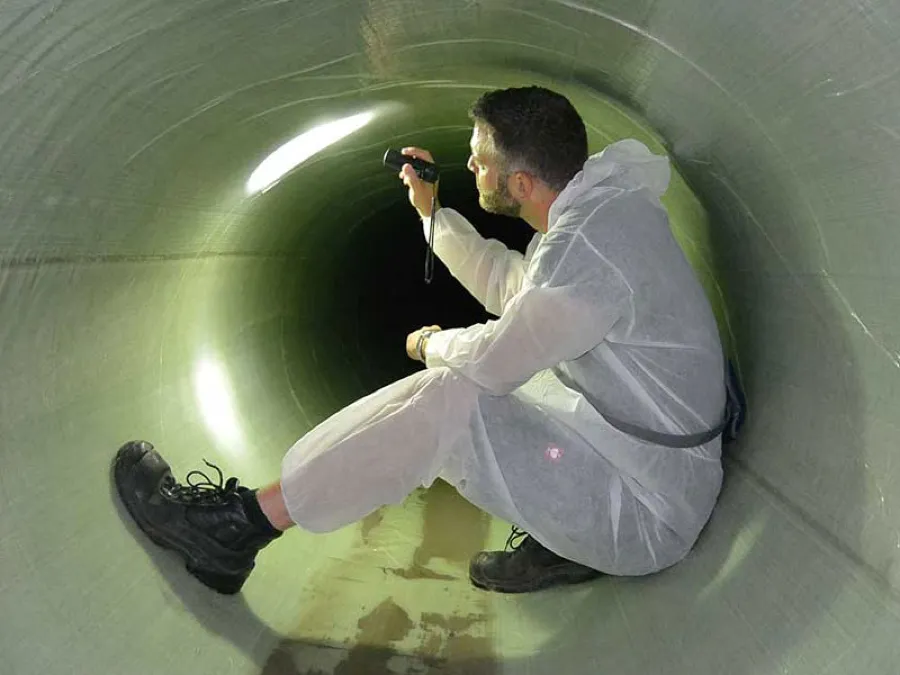
Stormwater pipe rehabilitation for Florida municipalities, explained
Florida's stormwater infrastructure is aging fast. Decades-old reinforced concrete pipe (RCP) and corrugated metal pipe (CMP) under roads, parking lots, and right-of-ways crack, corrode, and lose joints — and in our high-water-table, salt-air environment, they fail faster than in most of the country. Stormwater pipe rehabilitation is the process of restoring those failing storm lines to full structural strength without digging up the road above them. For most Florida cities and counties, the fastest and most cost-effective method is trenchless cured-in-place pipe (CIPP) lining.
American Water, Sewer & Drain is a Florida Certified Underground Utility Contractor (CUC 1225741) serving Vero Beach and municipalities statewide. We rehabilitate storm pipes from 2" to 110" in diameter using CIPP, supported by CCTV inspection, directional drilling, dewatering, and bypass pumping with our own Vactor fleet.
Why Florida storm pipes fail
Knowing why a line is failing tells you how to fix it. The most common causes municipal engineers see here are:
- Corrosion of corrugated metal pipe — Florida's groundwater and coastal salt accelerate rust-through, leaving open invert and exfiltration.
- Joint separation and infiltration — high water tables push groundwater and soil into the pipe, undermining the roadbed.
- Cracking and spalling in concrete pipe — decades of load cycling and hydrogen-sulfide attack degrade the host pipe.
- Voids and sinkholes — soil migrating into a leaking pipe creates voids that surface as roadway depressions and sudden collapses.
Left alone, these defects turn into emergency road closures. Rehabilitating before collapse is far cheaper than replacing after one.
How trenchless CIPP rehabilitation works
Cured-in-place pipe lining installs a new structural pipe inside the old one. The result is a jointless, corrosion-resistant liner engineered for a 50-year service life. The typical sequence is:
1. CCTV inspection and assessment
We send a camera through the line to grade defects, measure diameter, and confirm the rehabilitation method. This footage also gives the municipality a documented pre- and post-condition record for asset management and grant reporting.
2. Cleaning and flow control
Our Vactor trucks clean out sediment, roots, and debris. Where the line is carrying water — common in Florida's wet season — we set up dewatering and bypass pumping so the pipe can be lined dry.
3. Liner installation and curing
A resin-saturated felt or fiberglass liner is inverted or pulled into the host pipe through an existing manhole or small access pit, then cured in place. Once cured, it bonds into a new pipe wall that seals every crack and joint.
4. Reinstatement and final CCTV
Service and lateral connections are reopened robotically, and a final camera pass verifies the finished line. No trench, minimal pavement restoration, lanes back open.
Why municipalities choose trenchless over dig-and-replace
The direct answer: trenchless rehabilitation costs less, finishes faster, and disrupts the public far less. Open-cut replacement of a storm main means tearing up the road, hauling spoil, working around other utilities, restoring pavement, and closing lanes for weeks. CIPP avoids nearly all of that:
- No full roadway excavation — only short access points instead of an open trench.
- Lower restoration cost — most of an open-cut budget is pavement and surface repair, which CIPP largely eliminates.
- Faster project timelines — many runs are lined in a single day, reducing traffic-control and detour expense.
- Less risk to adjacent utilities — no digging means no struck water, sewer, gas, or fiber lines.
Sizes and conditions we handle
We line storm pipes from 2" laterals up to 110" mains approaching box-culvert scale. With CCTV, directional drilling, dewatering, and bypass capability in-house, we can rehabilitate lines regardless of flow, groundwater, or access constraints — and we self-perform the work as a licensed Florida CUC rather than subcontracting it out.
Plan your stormwater rehabilitation project
If your city or county has storm lines showing infiltration, sinkholes, or failing CMP, the right first step is a CCTV assessment to grade the system and scope a rehabilitation plan. American Water, Sewer & Drain can inspect, design, and rehabilitate your stormwater infrastructure trenchlessly, with no road dig-up. Call (833) 379-2973 or request a quote to get started.