
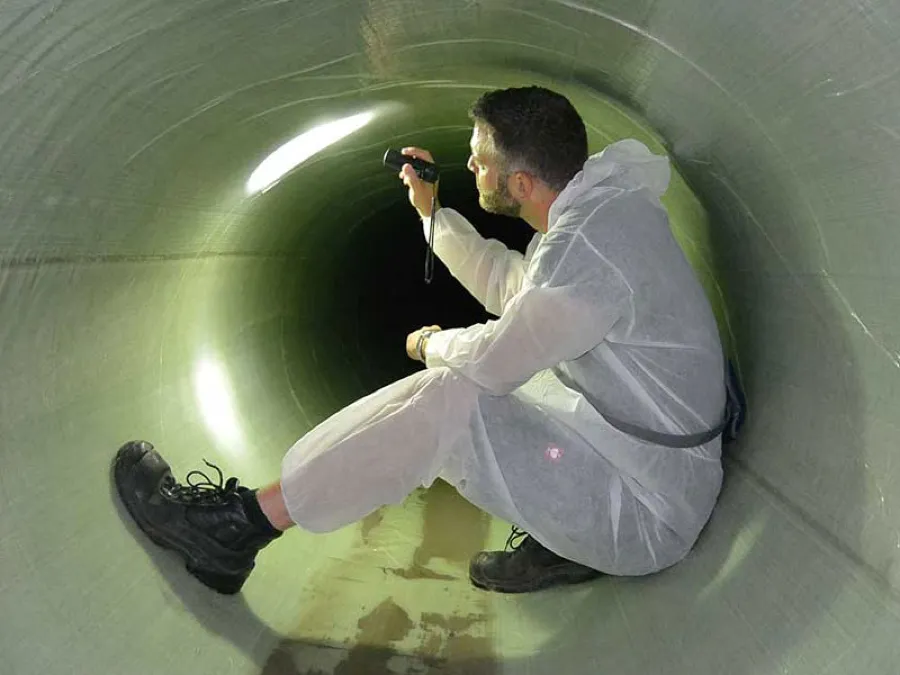
When a sewer main, storm line, or culvert fails, the first question isn't "how do we fix it" — it's "do we have to dig?" The answer drives your budget, your downtime, and how much of your parking lot, roadway, or landscaping you tear up. As a Florida State Certified Underground Utility Contractor (CUC 1225741), we run both trenchless rehab and full open-cut replacement, and we'll tell you straight which one your pipe actually needs.
What CIPP (Cured-In-Place Pipe) Actually Is
CIPP is a structural liner — a resin-saturated felt or fiberglass tube — installed inside your existing pipe and cured in place with hot water, steam, or UV light. Once it hardens, you have a jointless, corrosion-resistant "pipe within a pipe" that meets ASTM F1216 standards and typically carries a 50-year design life. No new trench, no new pipe in the ground. We line host pipes from 2 inches up to 110 inches in diameter, so the same crew can handle a residential lateral or a major municipal trunk line.
Dig-and-Replace: Still the Right Call Sometimes
Open-cut replacement means excavating down to the pipe, removing it, and laying new pipe. It's the proven method, and for some failures it's the only honest answer. You dig when:
- The host pipe is collapsed, badly offset, or has lost too much structural shape for a liner to follow
- You need to upsize for capacity — a liner slightly reduces inside diameter, it can't add it
- The line is shallow, short, and in open ground where excavation is cheap and fast
- Grade or alignment is the problem (sagging "belly"), which a liner will simply reproduce
Where Trenchless Saves Real Time and Money
You skip the expensive part — the hole
On most failures, the pipe itself is a fraction of the job cost. The real money is in excavation, traffic control, dewatering, shoring, backfill, compaction, and restoring whatever was on top — asphalt, concrete, curb, sidewalk, or sod. CIPP eliminates most of that. Access is usually through existing manholes or small access pits, so a job that would shut down a lane or a parking aisle for a week can often be lined in a day or two.
Less disruption under roads and infrastructure
This is why municipalities and FDOT lean trenchless. On work like the Kanner Highway project (E4V49, $1.42M) and PGA Village (WO9, $1.345M), rehabbing under live roadways and developed sites without ripping them open keeps traffic moving and slashes restoration cost. The same logic applies to a commercial property owner who can't afford to close half the lot.
One contractor, one mobilization
Fragmented jobs cost more. We run our own Vactor fleet for cleaning and bypass, our own trenchless rigs for lining, and we're bonded, licensed, and insured to handle the excavation if the inspection says dig. CCTV inspection, cleaning, lining or replacement, and final verification all come from one crew — no finger-pointing between subs, no second mobilization fee.
How We Decide — And You Should Too
It starts with a camera, not a guess. We run a CCTV inspection and, where needed, clean the line first so we can actually read its condition. From there it's straightforward: if the pipe holds its shape and grade, trenchless almost always wins on cost and downtime. If it's collapsed, sagging, or undersized, we'll recommend the dig — and we'll show you the footage so you understand why. Either way, the work is done to DOT-grade standards by a state-certified crew, not patched over to sell you a liner that won't last.
Talk to a Certified Underground Utility Contractor
Serving Vero Beach, the Treasure Coast, and statewide Florida, American Water, Sewer & Drain inspects first and recommends the method that's actually right for your pipe — trenchless or open-cut. If you've got a failing sewer, storm, or culvert line and you're not sure which way to go, call us at (833) 379-2973 or request a quote. We'll get a camera on it and give you a straight answer.