
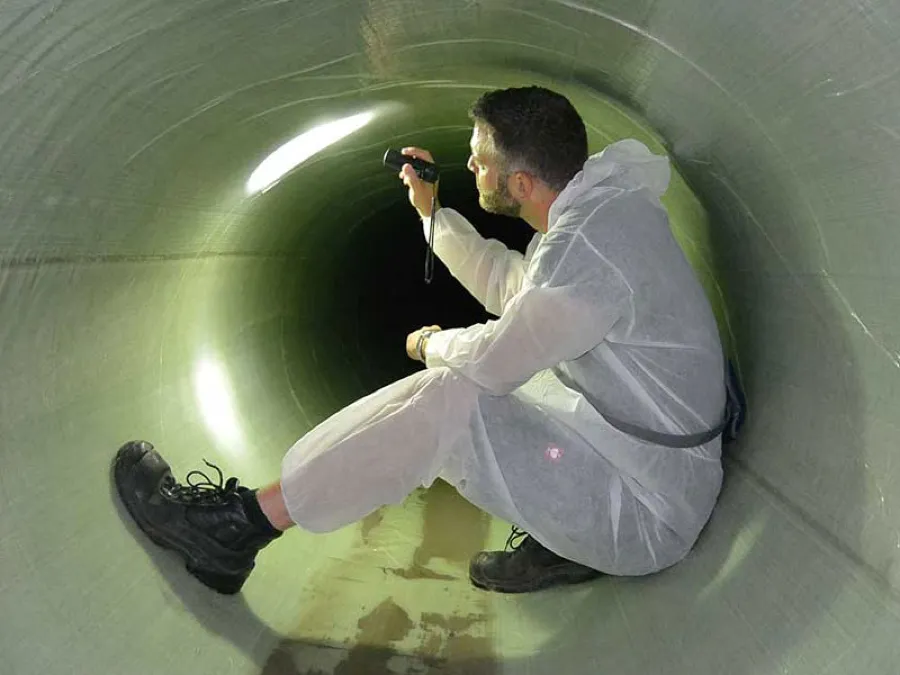
What is manhole-to-manhole CIPP?
Manhole-to-manhole CIPP (cured-in-place pipe) is a trenchless method that rehabilitates a sewer or storm main by installing a new structural pipe inside the old one, working from one manhole to the next. A resin-saturated felt or fiberglass liner is pulled or inverted into the host pipe, pressed tight against the existing wall, then cured into a hard, jointless pipe-within-a-pipe. The result spans the full run between two manholes with no field joints and no open trench across the road.
Because the work happens through existing access points, CIPP avoids the cost, traffic control, and surface restoration that come with dig-and-replace. For most gravity sewer and storm lines from 2 inches up to 110 inches in diameter, it is the fastest way to stop infiltration, seal cracks, and add decades of structural life.
How the CIPP process works, step by step
1. Inspect and clean the host pipe
Every lining job starts with cleaning. A Vactor combination truck jets and vacuums out roots, grease, sediment, and debris so the liner can seat against bare pipe wall. We then run a CCTV crawler camera through the line to record the pipe's true condition, confirm diameter, and locate every service lateral. That footage becomes the baseline that proves the pipe was sound before and after the cure.
2. Set up bypass and dewatering
The host pipe has to be empty during the cure. For active sewer mains, we install a bypass pump system that temporarily reroutes flow around the work zone so service is never interrupted. On lines with groundwater intrusion, common in coastal Florida's high water table, dewatering pumps keep the area dry until the resin sets.
3. Wet out and install the liner
The felt or fiberglass liner is impregnated ("wet out") with a two-part thermoset resin, then installed one of two ways. Inversion uses air or water pressure to turn the liner inside out as it enters the pipe, pressing resin against the wall. Pull-in-place winches the liner through and inflates a bladder to hold it tight. Either way, the liner runs continuously from manhole to manhole.
4. Cure the resin
Once positioned, the resin is cured to harden it into a solid pipe. Curing is done with hot water, steam, or UV light depending on the liner and diameter. Steam and UV cure faster, which shortens the bypass window. When curing finishes, the liner is a stiff, corrosion-resistant pipe bonded to the host.
5. Reinstate laterals and inspect
Lining covers over every service connection, so we send a robotic cutter back through to reopen each lateral exactly where the CCTV located it. A final camera pass verifies the laterals are open, the liner is tight, and the run is leak-free. We hand over the post-lining video as your record of the finished work.
When CIPP is the right choice
- Cracked, corroded, or root-infiltrated gravity sewer and storm mains
- Lines under roads, parking lots, or buildings where excavation is disruptive or impossible
- Pipes losing capacity to infiltration and inflow (I&I) during rain events
- Aging clay, cast iron, or concrete pipe that is still round but structurally failing
Severely collapsed or badly out-of-round pipe may need point repair, directional drilling for a new line, or open-cut replacement instead. The CCTV inspection tells us which path is right before any liner is ordered.
Why work with a certified underground utility contractor
CIPP is engineered work, not a patch. Liner thickness is calculated for the pipe's depth, diameter, and loading, and the cure has to hit the right temperature and time to reach full strength. American Water, Sewer & Drain is a Florida Certified Underground Utility Contractor (CUC 1225741) running an in-house Vactor fleet, CCTV inspection, directional drilling, dewatering, and bypass, so the whole job stays under one accountable crew from cleaning through final video.
Get a CIPP assessment for your line
Serving Vero Beach and clients statewide across Florida, we'll camera your line, tell you honestly whether CIPP or another method fits, and give you a clear scope. Call (833) 379-2973 or request a quote to schedule an inspection.