
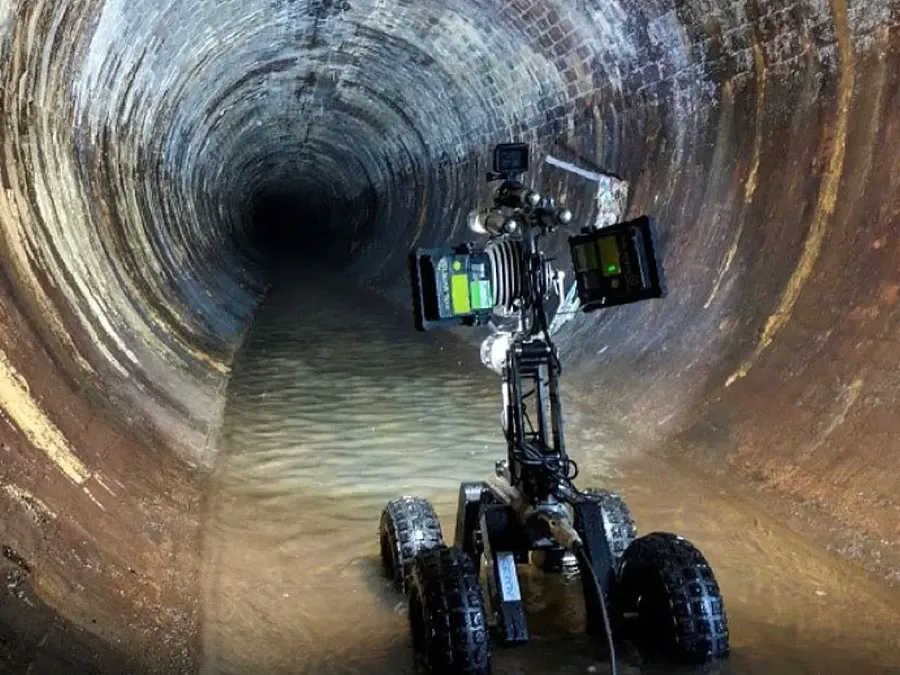
When a sewer backs up, a main breaks, or a drain won't drain, the temptation is to start digging. Don't. The most expensive mistake in underground utility work is repairing a pipe before you know what's actually wrong with it. At American Water, Sewer & Drain, every job starts the same way: we put a camera in the line first. Here's why that order is non-negotiable.
You Can't Fix What You Can't See
A pipe failure on the surface looks simple. A wet spot in the yard, a slow floor drain, a sinkhole over a lateral. But the cause can be twenty feet away and forty years old. CCTV (closed-circuit television) inspection sends a high-resolution, self-leveling camera through the line so we see the real condition of the pipe wall, the joints, the bedding, and the flow.
That footage tells us what no surface clue can:
- Whether the problem is a crack, an offset joint, a collapse, or just a root mass or grease blockage that needs cleaning, not replacement
- The exact distance to the defect, so we excavate in one place instead of guessing across a yard or a roadway
- The pipe material and diameter, which dictates whether a trenchless liner fits or open-cut is required
- Hidden secondary issues that would have failed six months after a partial fix
The Right Diagnosis Picks the Right Method
We run a full toolbox, and CCTV is what tells us which tool the job actually needs. We install cured-in-place pipe (CIPP) lining from 2 inches to 110 inches, run trenchless rehabilitation rigs, and operate a Vactor fleet for high-pressure cleaning and hydro-excavation. Each method has a right and wrong application.
Trenchless vs. Open Cut
A clean CCTV survey often shows a pipe that's structurally sound enough to line from the inside. That means no tearing up a driveway, a parking lot, or a state road. But lining a pipe that's already collapsed or badly offset is throwing good money after bad. The camera is what draws that line. Without it, you either over-dig a pipe that could have been lined, or you line a pipe that needed full replacement.
Clean First, Then Look
Grease, scale, and root intrusion can hide the actual defect and mimic a structural failure. We clean with the Vactor, then re-camera. Sometimes the "broken pipe" was a root ball, and the repair bill drops by tens of thousands of dollars.
It Holds Up on Public and Private Work Alike
On FDOT and municipal contracts, pre- and post-construction CCTV isn't optional, it's specified, and the footage becomes part of the as-built record. We've delivered that documentation on jobs like the Kanner Highway project (E4V49, $1.42M), District 5 work in Lake County, and PGA Village (WO9, $1.345M). The same standard a state inspector demands is the standard we bring to a homeowner's lateral. You get video proof of the problem before we touch it, and proof of the repair after.
That record matters for warranties, insurance claims, real estate disclosures, and HOA disputes. When the work is buried, the inspection is the only thing that lets you verify it was done right.
One Vendor, Start to Finish
Because we inspect, clean, and repair under one roof, there's no handoff where the diagnosis gets lost. The crew that reads the footage is the crew that fixes the pipe. We're a Florida State Certified Underground Utility Contractor (CUC 1225741), bonded, licensed, and insured, working across Vero Beach, the Treasure Coast, and statewide Florida.
If a contractor wants to start repairs without putting a camera down first, ask why. The inspection costs a fraction of the dig, and it's the only thing standing between you and paying for the wrong fix.
Have a line you're worried about? Call us at (833) 379-2973 or request a quote, and we'll get a camera on it before anyone breaks ground.