
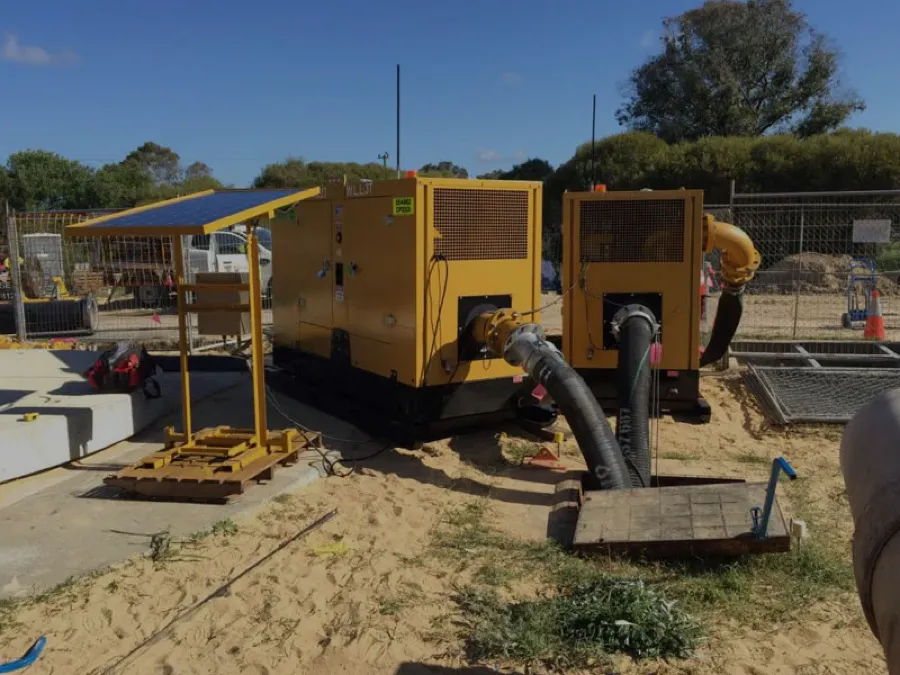
What is bypass pumping and why does it matter?
Bypass pumping is the temporary rerouting of sewage or wastewater around a section of pipe that needs to be repaired, relined, or replaced. In plain terms: before a crew can work on a live sewer main, the flow inside it has to go somewhere. Bypass pumping captures that flow upstream, moves it through temporary pipe, and discharges it back into the system downstream of the work zone, so the line can be emptied and repaired without backing sewage up into homes, streets, or the environment.
It is one of the most important and least visible parts of any underground utility job. Done right, nobody upstream even knows it is happening. Done wrong, you get backups, overflows, and serious regulatory exposure.
When is a sewer bypass required?
A bypass is needed any time the pipe has to be taken out of service while it still has flow moving through it. Common scenarios include:
- Trenchless CIPP lining — cured-in-place pipe liners need the host pipe clean, dry, and flow-free while the liner is installed and cured.
- Open-cut pipe replacement — when a section is excavated and swapped out, flow has to be diverted around the dig.
- Point repairs and pipe bursting — short structural fixes still require the line to be offline.
- Manhole rehabilitation and structural work — sealing or rebuilding a manhole means isolating it from active flow.
- Emergency main breaks — when a sewer main fails, a bypass keeps the area from flooding while the permanent repair is engineered.
How does bypass pumping actually work?
The process follows a deliberate sequence built around one goal: never let the flow get ahead of you.
1. Flow study and sizing
Crews measure or calculate the peak flow the line carries, including wet-weather surges. The bypass pumps and discharge pipe are sized to handle that peak, not the average. Undersizing a bypass is the single most common cause of overflows, which is why this step matters most.
2. Plugging and intake
An inflatable or mechanical plug isolates the work section. A suction line and pumps pull flow from the upstream manhole. Self-priming or submersible pumps are selected based on solids handling, lift, and run time.
3. Temporary discharge piping
Above-ground HDPE or layflat hose carries flow to a downstream access point. Road crossings get ramps or buried sleeves so traffic and pedestrians stay safe.
4. Redundancy and monitoring
A reliable bypass always includes standby pumps that kick on automatically if a primary unit fails, plus high-water alarms and around-the-clock monitoring. For long jobs, that monitoring is continuous until the line is back in service.
Why redundancy is non-negotiable
Sewage does not pause for equipment failures. A single pump losing prime at 2 a.m. during a storm can turn into a sanitary sewer overflow within minutes. That is why a properly engineered bypass is built with backup pumps, backup power or auto-start generators, leak-tight connections, and alarms. The cost of that redundancy is small compared to the cost of cleaning up a spill and answering for an environmental violation.
How bypass fits into a full trenchless repair
Bypass pumping rarely stands alone. On most projects it works alongside CCTV camera inspection to assess the pipe, hydro-jetting and Vactor cleaning to prep the line, dewatering to control groundwater in excavations, and the structural repair itself, whether that is CIPP lining or replacement. Coordinating all of these on a live system is where experience and the right equipment fleet make the difference.
Why work with a certified Florida underground contractor
American Water, Sewer & Drain is a Florida Certified Underground Utility Contractor (CUC 1225741) serving Vero Beach and clients statewide. We handle bypass pumping as part of a complete trenchless capability: CIPP lining from 2 inches to 110 inches, CCTV inspection, horizontal directional drilling, dewatering, and a Vactor fleet for cleaning and flow control. That means a single accountable crew can study your flow, size the bypass, keep sewage moving, and complete the permanent repair, without a spill and without shutting your property down.
Talk to a real underground crew
If you have a failing main, a planned relining project, or an emergency that needs flow controlled today, we can help. Call (833) 379-2973 or request a quote and we will walk you through the right approach for your line.